
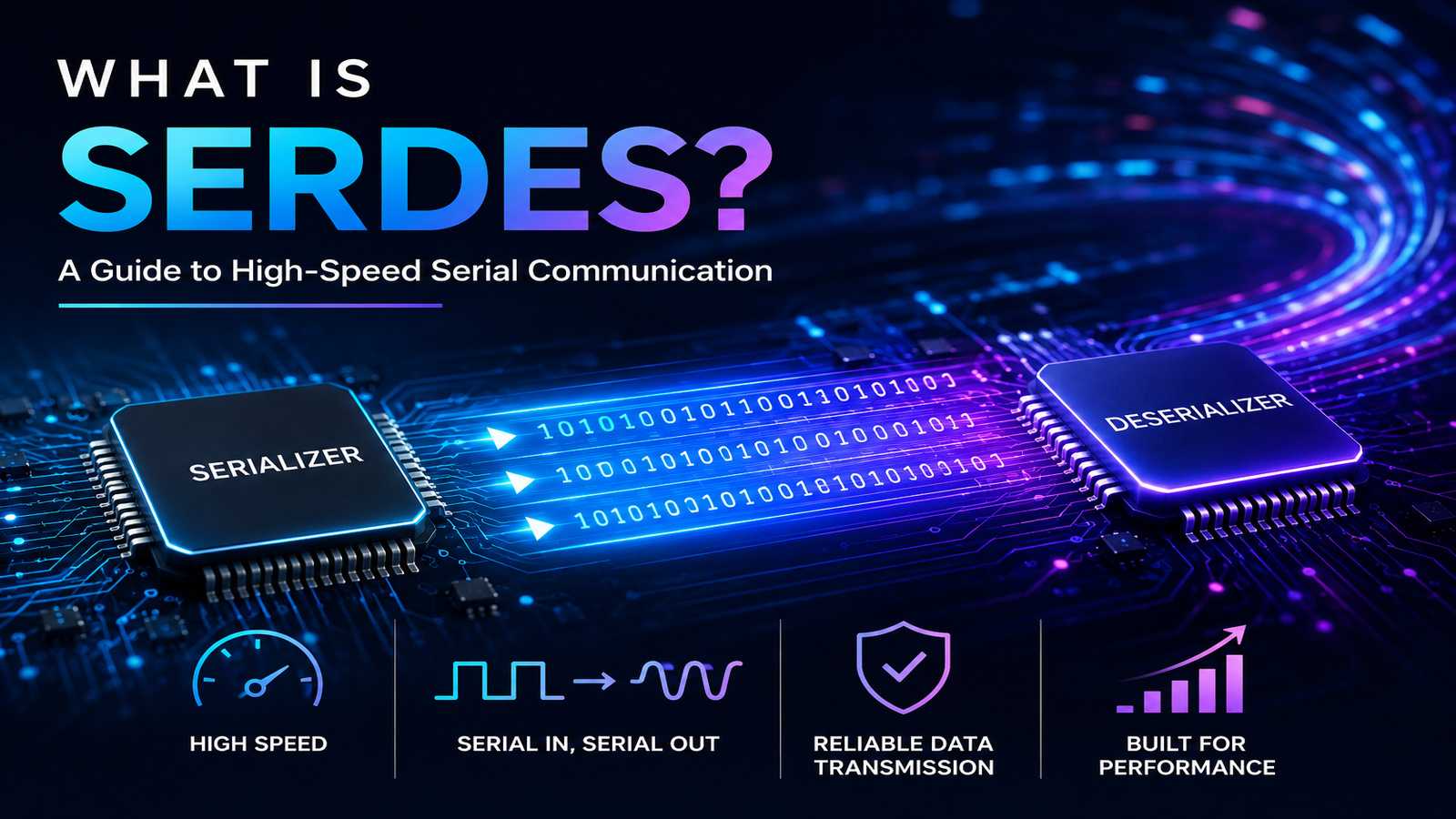
What Is SerDes? A Guide to High-Speed Serial Communication
Modern electronic systems need to move more data without continually increasing the number of physical connections between chips. SerDes, short for serializer/deserializer, addresses that problem by converting data between parallel and high-speed serial formats.
SerDes technology is now central to high-speed communication in data centers, networking equipment, optical modules, storage systems, and other bandwidth-intensive applications.
For engineers working with multi-gigabit links, understanding how a SerDes interface works also means understanding the practical limits imposed by the physical channel.
What Is SerDes?
SerDes stands for serializer/deserializer.
A SerDes converts multiple parallel data bits into a high-speed serial stream for transmission and then converts the serial stream back into parallel data at the receiving end.
A simplified link looks like this:
Parallel data → Serializer → High-speed serial channel → Deserializer → Parallel data
The main advantage is a reduction in the number of physical connections required to transfer the same amount of information.
Instead of sending many bits simultaneously across a wide parallel bus, SerDes sends data sequentially over one or more high-speed differential lanes.
This makes it possible to achieve high bandwidth while keeping interconnect size and pin count manageable.
How Does a SerDes Interface Work?
A typical SerDes interface contains a transmit path and a receive path.
Serializer
On the transmit side, the serializer takes parallel data and converts it into a serial bit stream.
The transmitter may also perform functions such as:
-
Pre-emphasis or transmit equalization
-
Clock generation
-
Signal conditioning
-
Output-driver control
The resulting serial signal travels through the physical channel.
High-Speed Channel
The channel can include PCB traces, connectors, packages, cables, backplanes, and other interconnect structures.
At high data rates, these are not electrically transparent.
Loss, reflections, crosstalk, impedance discontinuities, and jitter can degrade the signal before it reaches the receiver.
This is why SerDes design is closely connected to signal integrity and channel modeling.
Deserializer
At the receiving end, the deserializer recovers the serial data and converts it back into a parallel representation.
A high-speed receiver may also include equalization and clock and data recovery (CDR) circuitry to compensate for channel impairments and determine the timing of incoming data.
Also Check: Linear Pluggable Optics IC
Why Use SerDes Instead of Parallel Interfaces?
Parallel interfaces require multiple data lines and associated routing.
As the data rate increases, maintaining timing alignment between those lines becomes increasingly difficult. More pins also mean more PCB routing, package complexity, and potential crosstalk.
SerDes reduces the number of high-speed physical connections needed for a given data transfer.
The trade-off is that each serial lane must operate at a much higher data rate and requires considerably more attention to:
-
Signal integrity
-
Clock recovery
-
Equalization
-
Jitter
-
Channel loss
-
Transmitter and receiver design
So SerDes does not eliminate high-speed design challenges. It moves more of the problem into the electrical performance of each lane.
SerDes and Signal Integrity
At high data rates, the physical channel becomes part of the communication system.
A SerDes transmitter can generate a clean waveform at the IC output, but the receiver sees the signal after it has passed through the complete channel.
Loss can reduce high-frequency content, while reflections and impedance discontinuities can distort transitions. Crosstalk can introduce additional noise, and jitter can reduce timing margin.
This is why signal integrity analysis is an important part of SerDes development.
Engineers may use eye diagrams, channel models, S-parameters, simulation, and hardware measurements to determine whether a channel provides sufficient margin.
For FMAX Technologies, this relationship is particularly relevant because its high-speed mixed-signal IC capabilities include SerDes, CDR, PAM4, TIAs, and other technologies used in demanding communication links.
FMAX Technologies high-speed mixed-signal IC design services
What Is SerDes PHY?
A SerDes PHY is the physical-layer portion of a system responsible for transmitting and receiving high-speed electrical signals.
The PHY typically sits between the digital logic and the physical communication channel.
Depending on the architecture, a SerDes PHY can incorporate functions such as:
-
Serializer and deserializer
-
Transmit and receive equalization
-
Clock generation
-
Clock and data recovery
-
Analog front-end circuitry
-
Signal detection
-
High-speed I/O
The exact implementation depends on the protocol, data rate, channel characteristics, and system architecture.
It is useful to distinguish the PHY from the higher-level protocol logic: the PHY deals primarily with moving and recovering the physical signal, while protocol logic determines how the data is structured and interpreted.
Also Read: Signal Integrity
What Changes at 224G SerDes?
As SerDes speeds move into higher data-rate generations, the electrical margin available in the channel becomes increasingly constrained.
224G SerDes designs face challenges involving:
-
Channel loss
-
Package and connector discontinuities
-
Crosstalk
-
Jitter
-
Equalization
-
Power consumption
-
Thermal constraints
At these speeds, the IC, package, PCB, connector, and channel cannot be optimized independently.
The electrical behavior of the entire path needs to be considered during architecture and implementation.
SerDes, PAM4, and Higher Data Rates
Increasing the number of bits transmitted per symbol is one way to increase data throughput without proportionally increasing the symbol rate.
PAM4 uses four voltage levels to represent two bits per symbol. This can improve bandwidth efficiency, but the reduced voltage spacing between levels makes the link more sensitive to noise and other impairments.
Consequently, modern high-speed SerDes architectures often combine:
High-speed transmitter + channel + equalization + receiver + CDR
rather than relying on the transmitter and receiver alone.
FMAX’s existing work on PAM4 examines the trade-offs between PAM4 and NRZ signaling in high-speed communication systems.
PAM4 vs NRZ: Which Signaling Method Should You Choose?
SerDes Testing and Validation
Simulation can identify many channel problems before hardware is available, but physical validation remains essential.
A SerDes link may be evaluated for:
-
Eye opening
-
Jitter
-
Bit-error rate
-
Receiver sensitivity
-
Channel loss
-
Equalization performance
-
Compliance with the intended interface requirements
The important part is not simply collecting measurements. Engineers need to connect the observed failure to its physical cause.
For example, a closed eye could result from excessive channel loss, crosstalk, reflections, jitter, or insufficient equalization. The appropriate solution depends on which mechanism is limiting the link.
When Does SerDes Require Custom IC Design?
Standard SerDes components can work well when their electrical characteristics match the system requirements.
Custom development becomes more relevant when a design has requirements that cannot be met efficiently with an off-the-shelf solution, such as:
-
Unusual data rates
-
Specialized channel conditions
-
Custom equalization
-
High-bandwidth analog front ends
-
Integrated CDR requirements
-
Power or area constraints
-
Specialized instrumentation or optical interfaces
In these cases, the SerDes architecture needs to be considered alongside the package, PCB, channel, and application requirements.
FMAX Technologies provides mixed-signal IC design services for high-speed applications, including SerDes data aggregation, CDRs, PAM4, TIAs, PLL/VCO design, and other high-speed analog and mixed-signal functions.
FAQs About SerDes
SerDes, or serializer/deserializer, converts parallel data into a high-speed serial stream for transmission and converts the received serial data back into parallel data.
A SerDes interface is a high-speed communication interface that uses serializer and deserializer circuits to transfer data serially between devices.
A SerDes interface is a high-speed communication interface that uses serializer and deserializer circuits to transfer data serially between devices.
A SerDes PHY is the physical-layer circuitry responsible for transmitting, receiving, conditioning, and recovering high-speed signals.
SerDes design involves developing the transmitter, receiver, clocking, equalization, signal conditioning, and related circuitry required for reliable high-speed serial communication.
SerDes allows systems to transfer large amounts of data using fewer physical connections than wide parallel interfaces, although each serial lane requires careful management of signal integrity, timing, equalization, and power.