

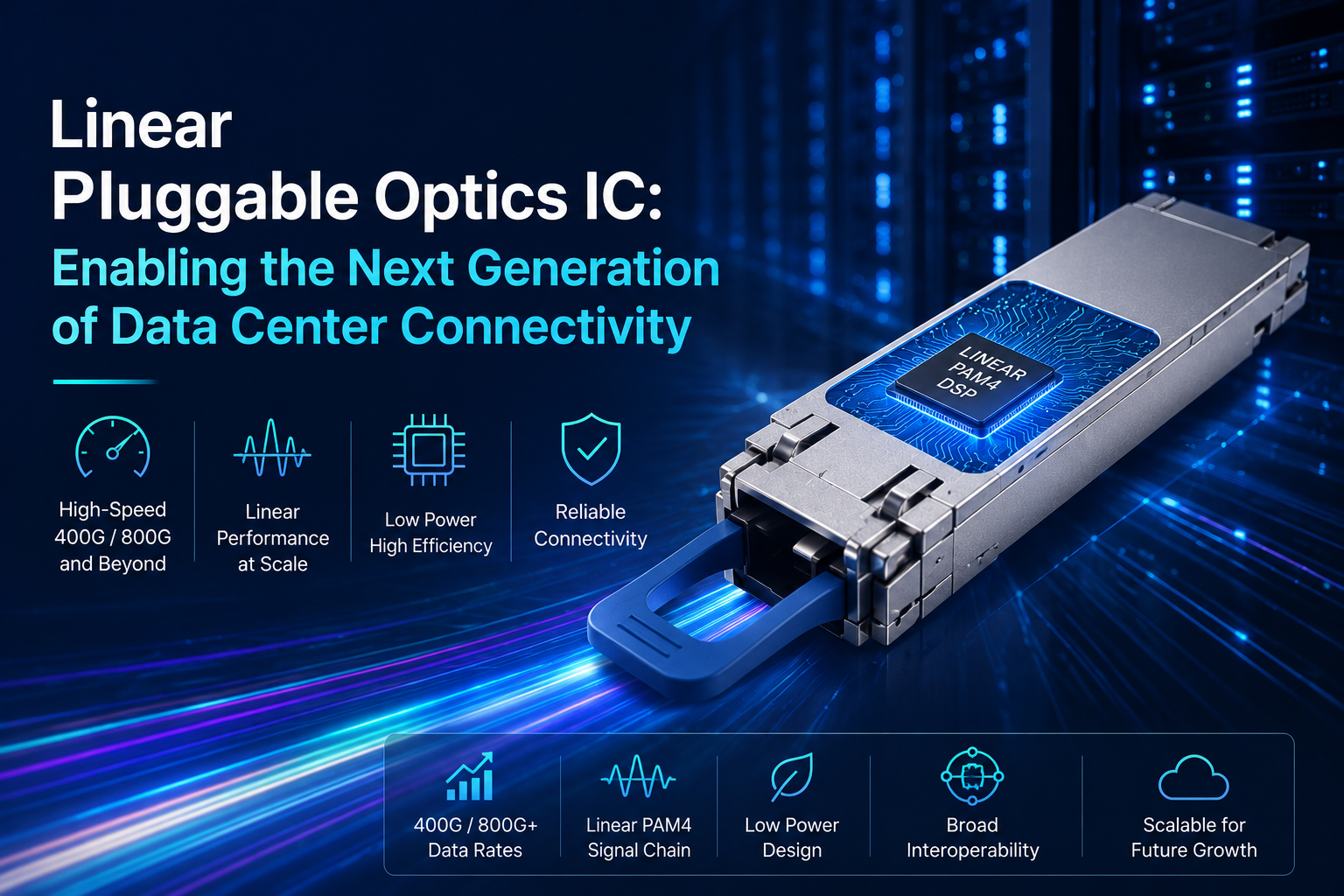
Linear Pluggable Optics IC: Enabling the Next Generation of Data Center Connectivity
Data center networks continue to evolve as cloud computing, artificial intelligence, and high-performance computing drive demand for greater bandwidth and lower power consumption. Traditional optical module architectures are increasingly challenged by higher data rates and growing infrastructure complexity.
Linear Pluggable Optics (LPO) has emerged as a promising approach for improving power efficiency while supporting high-speed optical communication. At the heart of this architecture are specialized integrated circuits that enable reliable signal transmission without relying on the full digital signal processing traditionally found in optical modules.
Linear Pluggable Optics IC solutions are becoming an important part of next-generation data center interconnect strategies.
What Is Linear Pluggable Optics?
Linear Pluggable Optics is an optical module architecture that reduces or eliminates the need for power-hungry digital signal processors (DSPs) inside optical transceivers.
Instead of performing extensive signal correction within the optical module, LPO systems rely on high-quality electrical signals generated by the host system and supporting ICs.
This approach can significantly reduce:
-
Power consumption
-
Latency
-
Module complexity
-
Thermal challenges
LPO technology is receiving significant attention in AI infrastructure and hyperscale data centers where power efficiency is becoming a major design consideration.
Why Linear Pluggable Optics Is Gaining Adoption
Modern AI clusters and cloud environments require thousands of optical links operating simultaneously.
As network speeds advance toward 800G and 1.6T Ethernet, power consumption associated with optical connectivity becomes increasingly important.
Linear Pluggable Optics offers several advantages:
Lower Power Consumption
Removing or reducing DSP functionality can significantly decrease optical module power requirements.
This becomes particularly valuable in large-scale deployments where even small reductions can result in substantial energy savings.
Reduced Latency
Traditional DSP processing introduces latency as signals are corrected and processed within the module.
LPO architectures help reduce processing delays, supporting faster communication between interconnected systems.
Improved System Efficiency
Lower power consumption simplifies cooling requirements and allows infrastructure operators to improve overall system efficiency.
The Role of ICs in Linear Pluggable Optics
The success of LPO depends heavily on high-performance integrated circuits capable of maintaining signal quality throughout the communication path.
Several IC technologies are critical to LPO implementations.
Laser Driver ICs
Laser drivers convert electrical data signals into optical transmission signals.
In LPO systems, laser driver performance becomes especially important because signal correction capabilities are reduced compared to traditional DSP-based architectures.
Key requirements include:
-
High bandwidth
-
Low jitter
-
Excellent linearity
-
Power efficiency
Transimpedance Amplifiers (TIAs)
TIAs convert photodiode current into usable electrical signals at the receiver.
Receiver sensitivity and noise performance play a major role in overall link reliability.
Clock and Data Recovery (CDR) ICs
CDRs help maintain synchronization and regenerate clean signals from incoming data streams.
Accurate timing recovery remains essential for maintaining communication integrity at high data rates.
Signal Conditioning and Equalization ICs
Without extensive DSP processing inside the module, signal conditioning becomes increasingly important.
Equalization and signal restoration circuits help compensate for channel impairments while preserving signal quality.
Design Challenges for Linear Pluggable Optics ICs
While LPO offers significant advantages, it also creates new engineering challenges.
Signal Integrity Requirements
Traditional DSP-based modules compensate for many signal impairments.
LPO architectures require stronger signal quality throughout the entire communication channel.
Engineers must carefully manage:
-
Channel loss
-
Noise
-
Crosstalk
-
Jitter
-
Reflections
High-Speed Operation
Supporting 800G and future 1.6T optical links requires advanced mixed-signal and analog circuit design techniques.
Bandwidth limitations become increasingly difficult to address as data rates continue to increase.
Power and Thermal Constraints
Although LPO reduces overall power consumption, IC designers must still optimize performance while minimizing energy usage and thermal impact.
Host System Requirements
LPO architectures place greater responsibility on host-side electronics to deliver clean signals capable of supporting reliable communication.
Applications of Linear Pluggable Optics
AI Infrastructure
AI training clusters require large numbers of high-speed optical links connecting servers, accelerators, and storage resources.
Power savings delivered by LPO architectures can have a significant impact on overall infrastructure efficiency.
Hyperscale Data Centers
Cloud operators continue to evaluate LPO technologies as a method for reducing operating costs and supporting future network expansion.
High-Speed Ethernet Networks
LPO solutions are increasingly being considered for 800G and next-generation Ethernet deployments where power efficiency is a primary concern.
High-Performance Computing
Research and enterprise computing environments require low-latency, high-bandwidth communication between distributed processing systems.
How FMAX Technologies Supports Linear Pluggable Optics Development
FMAX Technologies develops high-speed mixed-signal integrated circuits for optical communication, networking, datacenter, and instrumentation applications.
Our expertise includes laser drivers, transimpedance amplifiers (TIAs), Clock and Data Recovery (CDR) devices, signal processing architectures, and other high-speed analog and mixed-signal technologies used in advanced optical communication systems.
Through our mixed-signal IC design services, we help customers address signal integrity, timing, power efficiency, and connectivity challenges associated with next-generation optical interconnect platforms.
The Future of Linear Pluggable Optics
As AI infrastructure continues to scale and data center operators seek greater efficiency, Linear Pluggable Optics is expected to play an increasingly important role in optical networking.
Future developments will focus on:
-
Higher-speed optical interfaces
-
Improved power efficiency
-
Better signal integrity performance
-
Increased integration levels
-
Support for 1.6T and future networking standards
The continued advancement of high-speed mixed-signal IC technology will be essential for enabling these next-generation optical communication systems.
FAQs About Linear Pluggable Optics IC
Linear Pluggable Optics is an optical transceiver architecture that reduces or eliminates DSP functionality inside the module to improve power efficiency and reduce latency.
LPO helps reduce power consumption and cooling requirements while supporting the high-bandwidth communication needed for AI workloads.
Key components include laser driver ICs, transimpedance amplifiers (TIAs), Clock and Data Recovery (CDR) devices, and signal conditioning circuits.
Traditional optical modules rely heavily on DSPs for signal correction, while LPO architectures depend more on high-quality analog and mixed-signal circuit performance.
The primary benefits include lower power consumption, reduced latency, improved system efficiency, and simplified optical module architectures.