
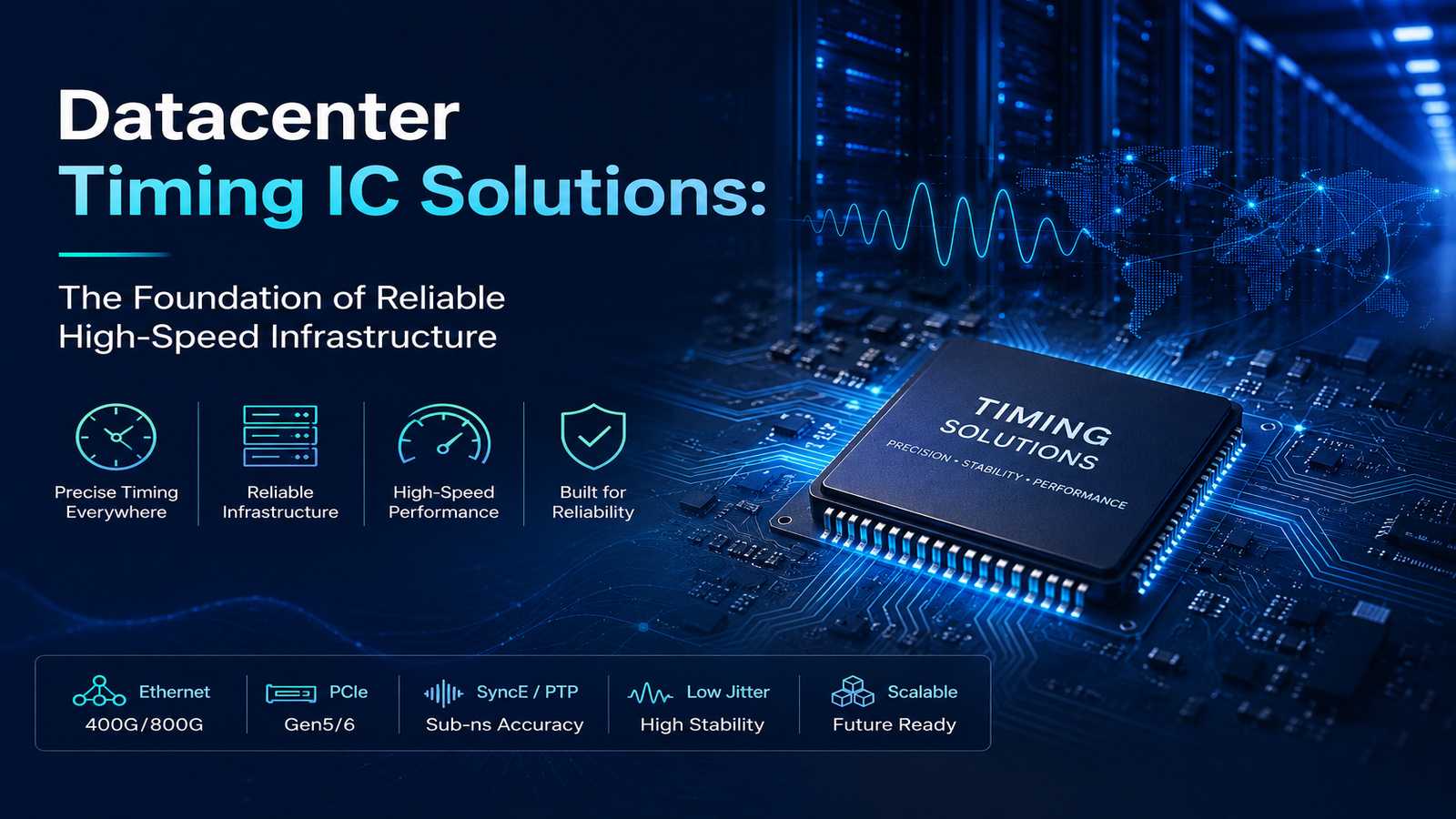
Datacenter Timing IC Solutions: The Foundation of Reliable High-Speed Infrastructure
Modern data centers depend on precise synchronization to move massive amounts of data across servers, switches, storage systems, and networking equipment. As Ethernet speeds continue to increase and AI workloads place greater demands on infrastructure, timing accuracy has become a critical design requirement.
Datacenter timing IC solutions provide the clock generation, synchronization, and signal conditioning functions needed to keep complex systems operating reliably. Without accurate timing, even the most advanced networking hardware can experience degraded performance, increased latency, and higher error rates.
What Are Datacenter Timing IC Solutions?
Datacenter timing IC solutions are integrated circuits that generate, distribute, recover, and manage timing signals throughout high-speed electronic systems.
These devices ensure that processors, network interfaces, optical modules, memory subsystems, and accelerators operate using synchronized clock references. Timing ICs are commonly found in:
-
Ethernet switches
-
Network interface cards (NICs)
-
Optical communication modules
-
AI and machine learning servers
-
Storage platforms
-
Telecom and cloud infrastructure
As network speeds move from 100G to 400G, 800G, and beyond, timing performance becomes increasingly important for maintaining signal integrity and system reliability.
Why Timing Matters in Modern Data Centers
Every digital system relies on timing signals to coordinate data movement between devices. When clock signals become unstable or unsynchronized, communication errors can occur.
In high-speed environments, timing issues may lead to:
-
Increased bit error rates
-
Packet retransmissions
-
Reduced throughput
-
Higher latency
-
System instability
Accurate timing helps ensure that data arrives when expected and is processed correctly throughout the network.
For hyperscale data centers and AI clusters, synchronization across thousands of interconnected devices is essential for maintaining performance and efficiency.
Key Functions of Datacenter Timing ICs
Clock Generation
Clock generators create the reference frequencies required by processors, networking devices, memory systems, and communication interfaces.
These clocks must remain stable across varying operating conditions while maintaining low phase noise and minimal jitter.
Clock Distribution
A single reference clock often needs to be delivered to multiple subsystems.
Clock distribution ICs replicate timing signals while preserving accuracy and minimizing signal degradation across the system.
Jitter Attenuation
Jitter refers to unwanted variations in signal timing.
Even small amounts of jitter can affect high-speed communication links. Jitter attenuation circuits help clean incoming clock signals before they reach critical devices and interfaces.
Timing Recovery
Many communication systems recover timing information directly from incoming data streams.
Timing recovery circuits reconstruct clock signals and help maintain synchronization across network equipment and optical communication links.
Applications of Datacenter Timing IC Solutions
High-Speed Ethernet Networking
Modern switches and routers rely on accurate timing to support reliable packet transmission at increasingly higher data rates.
Timing ICs help maintain synchronization across multiple ports and communication channels.
AI and Machine Learning Infrastructure
AI training and inference platforms require continuous communication between processors, accelerators, memory resources, and networking hardware.
Precise timing helps reduce communication bottlenecks and supports efficient workload execution.
Optical Communication Systems
Optical interconnects depend on stable clock references for reliable data transmission.
Timing ICs play an important role in supporting optical modules, coherent communication systems, and high-speed datacenter links.
Storage and Computing Platforms
Storage arrays and server architectures rely on synchronized operation across multiple subsystems.
Accurate timing contributes to predictable performance and reliable data movement throughout the platform.
Design Challenges for Datacenter Timing ICs
Developing timing solutions for modern infrastructure involves several engineering challenges.
Ultra-Low Jitter Requirements
As data rates increase, acceptable timing margins become smaller. Timing ICs must deliver extremely low jitter performance to support reliable communication.
Power Efficiency
Large-scale data centers prioritize energy efficiency. Timing architectures must balance performance with power consumption requirements.
Signal Integrity
Clock signals must remain stable despite noise, interference, and complex board-level routing conditions.
Scalability
Timing solutions should support future network upgrades without requiring significant redesign efforts.
How FMAX Technologies Supports High-Speed Infrastructure
FMAX Technologies develops high-speed mixed-signal integrated circuits for datacenter, networking, optical communication, and instrumentation applications.
Our expertise includes signal processing, clock recovery, high-speed connectivity, and mixed-signal IC development used in advanced communication systems. Through our mixed-signal IC design services, we help customers address timing, signal integrity, and performance challenges associated with next-generation networking and datacenter platforms.
Choosing the Right Timing Architecture
Selecting a timing solution depends on several factors:
-
Required jitter performance
-
Supported data rates
-
Clock frequency requirements
-
Power consumption targets
-
Synchronization standards
-
System scalability goals
A well-designed timing architecture can improve overall system reliability while supporting future technology upgrades.
The Future of Datacenter Timing Solutions
The rapid growth of cloud computing, AI infrastructure, and high-speed networking continues to increase demand for advanced timing technologies.
Future data center platforms will require greater synchronization accuracy, lower latency, and support for faster communication standards. Timing IC solutions will remain a foundational component of these systems, enabling reliable operation across increasingly complex infrastructure.
FAQs About Datacenter Timing IC Solutions
A datacenter timing IC is a semiconductor device that generates, distributes, synchronizes, or recovers clock signals used in networking, computing, storage, and communication equipment.
Low jitter helps maintain signal integrity and reduces communication errors, particularly in Ethernet, optical, and high-speed interconnect applications.
Timing ICs are commonly used in switches, routers, servers, storage systems, network interface cards, and optical communication modules.
They provide synchronized clock references that enable efficient communication between processors, accelerators, memory systems, and networking equipment.
Key factors include jitter performance, clock frequency support, power consumption, synchronization requirements, scalability, and system-level integration needs.