
What Is a Laser Driver?
A laser diode cannot be connected directly to a high-speed data source and expected to produce a clean optical signal. Its current has to be controlled within a defined operating range, while the modulation signal must be delivered with enough bandwidth and accuracy for the intended data rate.
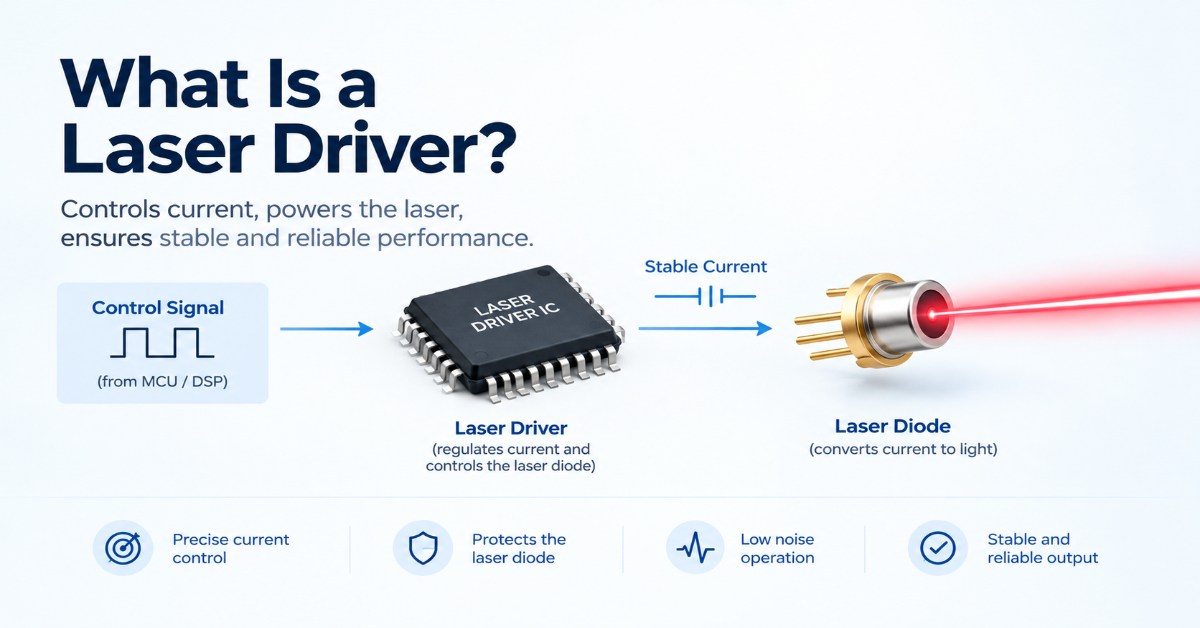
A laser driver is the IC that performs this electrical-to-optical interface function. In high-speed optical communication, the driver controls the bias and modulation of the laser diode while maintaining the electrical characteristics needed for reliable data transmission.
For modern optical transceivers, the laser driver is therefore part of the high-speed signal path, not simply a power-control circuit.
What Does a Laser Driver IC Do?
A laser driver IC controls the electrical current delivered to a laser diode.
Two current components are particularly important:
Bias current keeps the laser diode operating around its required operating point.
Modulation current changes the laser output in response to the incoming electrical data signal.
The driver has to control both without introducing excessive noise, distortion or timing uncertainty. At higher data rates, the output stage also has to maintain the required bandwidth and signal integrity while driving the electrical and optical load.
This is why a high-speed laser driver requires considerably more than basic current regulation.
How Does a Laser Driver Work?
The incoming electrical data is processed by the driver and used to control the current through the laser diode.
The exact architecture depends on the laser technology and application, but a high-speed laser driver may include current-control circuits, modulation stages, equalization, monitoring and programmable settings.
The output stage is particularly important. Parasitic capacitance, package effects and interconnects can limit bandwidth or alter the waveform delivered to the laser. At high baud rates, these effects can become part of the overall transmitter performance.
A laser driver therefore has to be designed around the laser, package and channel rather than treated as an isolated current source.
What Matters in a High-Speed Laser Driver?
For optical communication, several parameters directly affect transmitter performance.
Bandwidth
The driver needs sufficient bandwidth to reproduce the required modulation signal at the target data rate. Insufficient bandwidth can slow transitions and reduce the available eye opening.
Modulation Linearity
Linearity becomes important when the transmitter has to preserve the relationship between the electrical drive signal and optical output. This is particularly relevant in linear optical architectures.
Jitter
Timing variation in the electrical drive signal can contribute to transmitter jitter. At high data rates, relatively small timing errors consume part of the available signal margin.
Output Current
The driver must provide the required bias and modulation current without excessive power dissipation or distortion.
Power and Thermal Performance
High-speed output stages can consume substantial power. Heat affects both the driver and laser characteristics, so power efficiency and thermal behavior have to be considered at the IC and system levels.
Laser Driver ICs in Optical Transceivers
In an optical transceiver, the laser driver sits on the transmit side and interfaces the electrical data path with the optical source.
Its performance is closely connected to the rest of the transceiver. CDRs, SerDes, equalization, the laser driver and the optical device all contribute to the final transmitter behavior.
For example, a transmitter can have a high-quality data source but still lose performance if the laser driver introduces excessive bandwidth limitation, jitter or distortion.
For a broader look at the ICs used around optical transmitters and receivers, see FMAX’s article on chip design for optical transceivers.
Why Are Laser Drivers Important in Linear Pluggable Optics?
Linear pluggable optics place greater emphasis on the analog performance of the optical module. When more signal processing is left to the host system, the electrical and optical components inside the module need to preserve the signal with minimal degradation.
That puts greater demands on the laser driver.
Bandwidth, linearity, output swing, power consumption and signal integrity all become important when designing a driver for high-speed linear optical links.
FMAX’s current laser-driver portfolio includes the FX551, a linear quad VCSEL driver listed for 112 Gbps data-center interconnect applications. Its product documentation specifies 40 GHz bandwidth and 60 Gbaud-per-channel operation, along with features such as equalization, programmable current settings and monitoring support.
Check: What Is a Time Domain Reflectometer (TDR)
Laser Driver IC Design Challenges
The difficult part of laser driver design is balancing speed, output drive, linearity and power within a very small electrical and physical budget.
At high data rates, designers have to account for:
-
Package and interconnect parasitics
-
Laser impedance and capacitance
-
Output-stage bandwidth
-
Modulation linearity
-
Jitter and noise
-
Power dissipation
-
Process, voltage and temperature variation
The driver also has to work with the characteristics of the selected laser. A design that performs well with one optical source may not provide the same results with another.
For custom applications, the IC architecture, package and optical interface therefore need to be considered together.
Laser Driver vs. Laser Driver IC
A laser driver describes the function of controlling a laser diode, while a laser driver IC refers to that function implemented as an integrated circuit.
In simple systems, the distinction may not matter. In high-speed optical communication, the IC implementation becomes important because bandwidth, parasitics, power, modulation performance and integration all affect the final transmitter.
Read: What Is a Transimpedance Amplifier?
Where Are High-Speed Laser Driver ICs Used?
High-speed laser drivers are used in applications where an electrical data signal must drive an optical source at high speed, including:
-
Data-center optical interconnects
-
Optical transceivers
-
Linear pluggable optics
-
AI and high-bandwidth interconnects
-
High-speed networking equipment
The requirements vary by laser technology, data rate and system architecture, so the appropriate driver is determined by the complete transmitter design rather than by output current alone.
Laser Driver IC Design for High-Speed Optical Systems
A laser driver may need to meet requirements that are difficult to satisfy with a standard component, particularly when bandwidth, power, linearity, packaging or integration constraints are tightly coupled.
FMAX Technologies develops high-speed mixed-signal ICs for optical and data-center applications, including laser drivers, TIAs, CDRs and related high-speed channel circuitry.
For teams developing a high-speed optical transmitter or a custom laser driver IC, FMAX can support the analog and mixed-signal design work around the required architecture.
FAQs: FAQs: What Is a Laser Driver
A laser driver is an electronic circuit that controls the current used to operate and modulate a laser diode.
A laser driver IC integrates the circuitry required to bias and modulate a laser diode into an integrated circuit designed for a particular application and performance range.
Bias current establishes the laser's operating point, while modulation current changes the laser output in response to the transmitted data signal.
Insufficient bandwidth can distort or slow the modulation signal, reducing transmitter performance at high data rates.
The laser driver directly affects how accurately the electrical data signal is converted into optical modulation, making its bandwidth, linearity, jitter, power and output characteristics important to overall transceiver performance.