

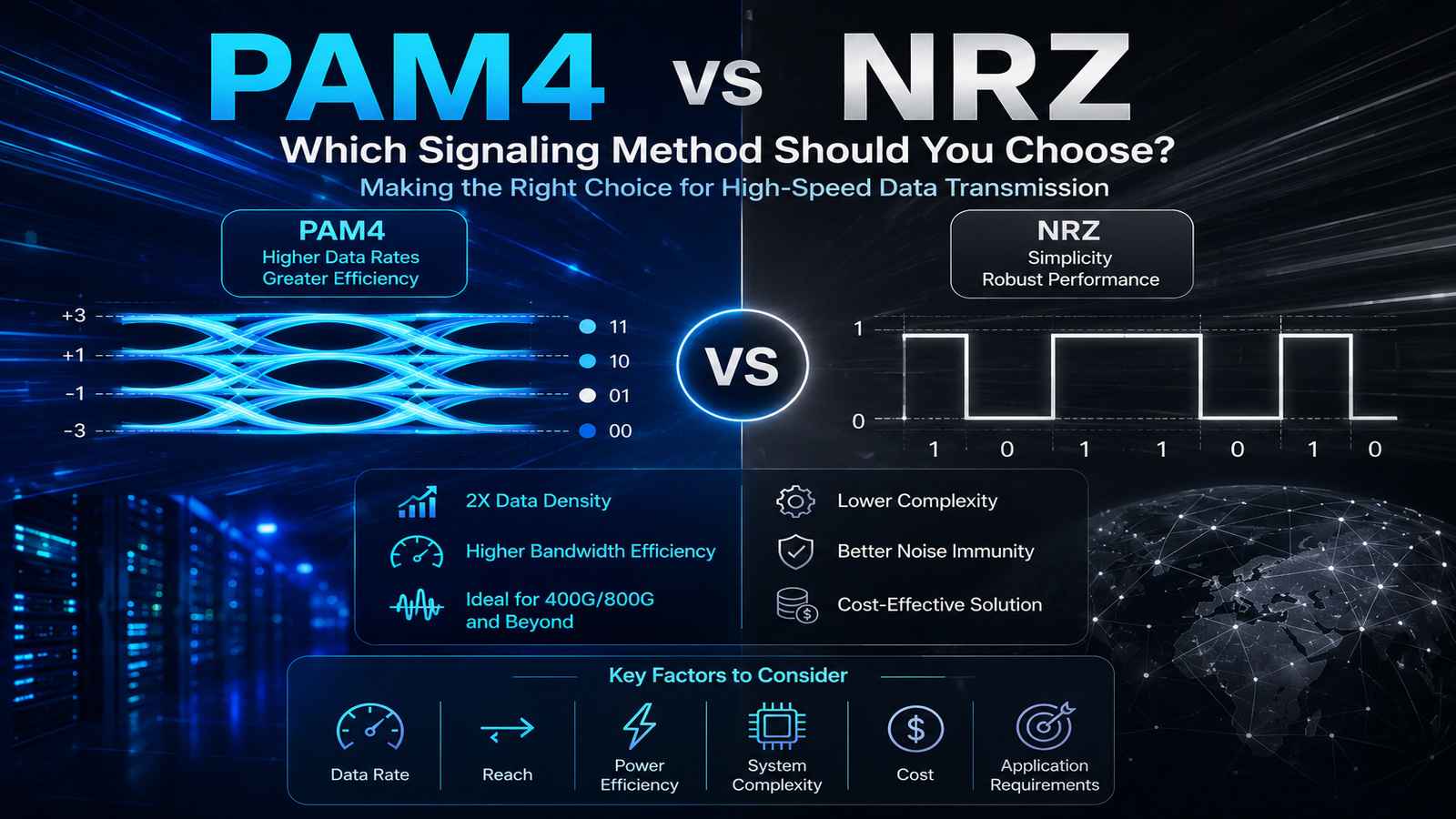
PAM4 vs NRZ: Which Signaling Method Should You Choose?
As Ethernet speeds move from 25G and 50G to 100G, 400G, 800G, and beyond, choosing the right signaling method becomes one of the earliest design decisions in any high-speed communication system. The choice between PAM4 (Pulse Amplitude Modulation with four levels) and NRZ (Non-Return-to-Zero) affects bandwidth efficiency, signal integrity, power consumption, system complexity, and overall implementation cost.
While NRZ remains a practical option for many lower-speed interfaces, PAM4 has become the preferred signaling scheme for modern data centers, AI clusters, and high-bandwidth optical interconnects. Understanding where each technology fits helps engineers design systems that meet both performance and reliability requirements.
PAM4 vs NRZ at a Glance
|
Feature |
NRZ |
PAM4 |
|---|---|---|
|
Signal Levels |
2 |
4 |
|
Bits Per Symbol |
1 |
2 |
|
Bandwidth Efficiency |
Lower |
Higher |
|
Signal-to-Noise Margin |
Higher |
Lower |
|
Design Complexity |
Lower |
Higher |
|
Equalization Requirements |
Moderate |
Advanced |
|
Typical Applications |
PCIe, SATA, USB, lower-speed Ethernet |
200G, 400G, 800G Ethernet, Optical Modules, AI Networks |
For applications that need to transmit more data without increasing channel bandwidth, PAM4 offers a significant advantage.
What Is NRZ Signaling?
NRZ is the traditional signaling method used in many digital communication systems. It represents information using two voltage levels:
-
Logic 0
-
Logic 1
Each symbol carries one bit of information, making NRZ relatively simple to design, validate, and troubleshoot.
Advantages of NRZ
-
Simple transmitter and receiver architecture
-
Better noise immunity
-
Larger eye opening
-
Lower DSP requirements
-
Easier signal integrity optimization
-
Lower implementation cost
Because only two voltage levels must be distinguished, NRZ systems generally achieve lower bit error rates under comparable channel conditions.
What Is PAM4 Signaling?
PAM4 uses four distinct voltage levels instead of two. Each symbol represents two bits, effectively doubling the amount of information transmitted without doubling the symbol rate.
Instead of transmitting:
-
0
-
1
PAM4 transmits combinations such as:
-
00
-
01
-
10
-
11
This enables significantly higher data throughput while operating within the same channel bandwidth.
Why Has the Industry Moved Toward PAM4?
Increasing serial data rates eventually reach the physical limitations of copper traces, connectors, packages, and optical channels. Raising the clock frequency further introduces greater insertion loss, jitter, and electromagnetic interference.
PAM4 addresses this challenge by increasing data density rather than symbol rate.
For example:
-
56 Gbps using NRZ requires approximately a 56 Gbaud symbol rate.
-
56 Gbps using PAM4 requires only about a 28 Gbaud symbol rate.
Reducing the symbol rate helps existing channels support higher throughput without requiring proportionally higher bandwidth.
This shift has made PAM4 the standard for modern Ethernet and optical communication systems.
PAM4 vs NRZ: Signal Integrity Considerations
Although PAM4 improves bandwidth efficiency, it introduces new signal integrity challenges.
Because four voltage levels occupy the same voltage swing that NRZ divides into two levels, each eye opening becomes much smaller.
This makes PAM4 more sensitive to:
-
Random jitter
-
Deterministic jitter
-
Thermal noise
-
Crosstalk
-
Channel loss
-
Reflections
-
Power supply noise
Maintaining reliable communication often requires:
-
Advanced equalization
-
Forward Error Correction (FEC)
-
Precise clock recovery
-
Careful PCB design
-
Optimized package design
-
High-performance analog front ends
For this reason, PAM4 system design extends well beyond selecting a signaling format—it requires optimization across the entire communication channel.
Power Consumption and System Complexity
One of the trade-offs associated with PAM4 is increased design complexity.
Compared with NRZ systems, PAM4 implementations typically include:
-
More sophisticated Digital Signal Processing (DSP)
-
Stronger equalization algorithms
-
Forward Error Correction
-
More precise clock and data recovery
-
Improved analog linearity
These features improve performance but also increase silicon complexity and power consumption.
Design teams must balance bandwidth requirements against thermal constraints, especially in dense data center environments.
Typical Applications for NRZ
NRZ continues to be widely used where bandwidth requirements remain within practical limits.
Common applications include:
-
USB interfaces
-
SATA storage
-
PCI Express
-
Industrial communication
-
Embedded systems
-
Automotive electronics
-
Lower-speed Ethernet links
Its simplicity makes it an excellent choice when signal integrity margins are more important than maximum bandwidth efficiency.
Typical Applications for PAM4
PAM4 has become essential for applications requiring extremely high throughput.
These include:
-
400G Ethernet
-
800G Ethernet
-
AI infrastructure
-
Hyperscale data centers
-
High-performance computing
-
Optical transceivers
-
Co-packaged optics
-
InfiniBand networks
-
High-speed switch ASICs
These systems demand maximum bandwidth within limited channel resources, making PAM4 the preferred signaling technology.
How High-Speed IC Design Supports PAM4 Performance
Reliable PAM4 communication depends on much more than digital modulation.
Several high-speed integrated circuits contribute to overall link performance, including:
-
Clock and Data Recovery (CDR) ICs
-
Laser Driver ICs
-
Transimpedance Amplifiers (TIAs)
-
High-speed equalizers
-
Redriver ICs
-
Precision timing circuits
Each component must maintain signal quality while minimizing jitter, distortion, and latency across the communication path.
Careful mixed-signal IC design ensures that these building blocks operate together to meet demanding performance targets.
Should You Choose PAM4 or NRZ?
The right choice depends on your system requirements rather than one technology being universally better.
Choose NRZ when your design prioritizes:
-
Simpler implementation
-
Lower power consumption
-
Better noise margin
-
Lower development complexity
-
Moderate data rates
Choose PAM4 when your application requires:
-
Maximum bandwidth efficiency
-
200G, 400G, or 800G networking
-
Optical interconnects
-
AI and cloud infrastructure
-
Higher throughput without doubling channel bandwidth
As communication speeds continue to increase, many next-generation networking platforms are adopting PAM4 because it delivers greater data capacity while making efficient use of existing physical channels.
Designing High-Speed Communication Systems with Confidence
Selecting between PAM4 and NRZ is only one part of designing a reliable high-speed communication system. Achieving consistent performance also depends on signal integrity, timing accuracy, equalization strategies, and the quality of the underlying integrated circuits.
FMAX Technologies develops high-speed analog and mixed-signal IC solutions for optical networking, instrumentation, and advanced communication systems. With expertise in Clock and Data Recovery (CDR) ICs, Laser Driver ICs, Transimpedance Amplifiers (TIAs), Copper Redriver ICs, and custom mixed-signal IC design, FMAX helps equipment manufacturers address the challenges associated with next-generation high-speed interfaces.
Whether your project involves optical transceivers, AI networking infrastructure, or high-bandwidth communication systems, selecting the appropriate signaling method-and supporting it with robust IC architecture-is fundamental to long-term performance and scalability.
FAQs: PAM4 vs NRZ
No. NRZ remains the preferred choice for many lower-speed applications where simplicity, lower power consumption, and better noise margins are more important than maximum bandwidth.
PAM4 transmits two bits per symbol, allowing higher data rates without doubling the channel bandwidth. This makes it practical for modern high-speed Ethernet and optical communication systems.
Most high-speed PAM4 implementations use FEC because the reduced eye openings make the signal more susceptible to errors compared with NRZ.
Modern 400G, 800G, and emerging 1.6T optical transceivers commonly use PAM4 to achieve higher bandwidth efficiency, while lower-speed optical modules may still rely on NRZ depending on system requirements.