
Chip Design for Optical Transceivers: Enabling High-Speed Data Center and Network Connectivity
The demand for faster data transmission continues to grow as cloud computing, artificial intelligence, high-performance computing, and hyperscale data centers expand worldwide. At the center of this infrastructure are optical transceivers, which convert electrical signals into optical signals and vice versa, enabling high-bandwidth communication across servers, switches, storage systems, and network equipment.
The performance of an optical transceiver depends heavily on the integrated circuits inside it. Chip design for optical transceivers plays a critical role in achieving higher data rates, lower power consumption, improved signal integrity, and reliable communication across modern networking environments.
What Is an Optical Transceiver?
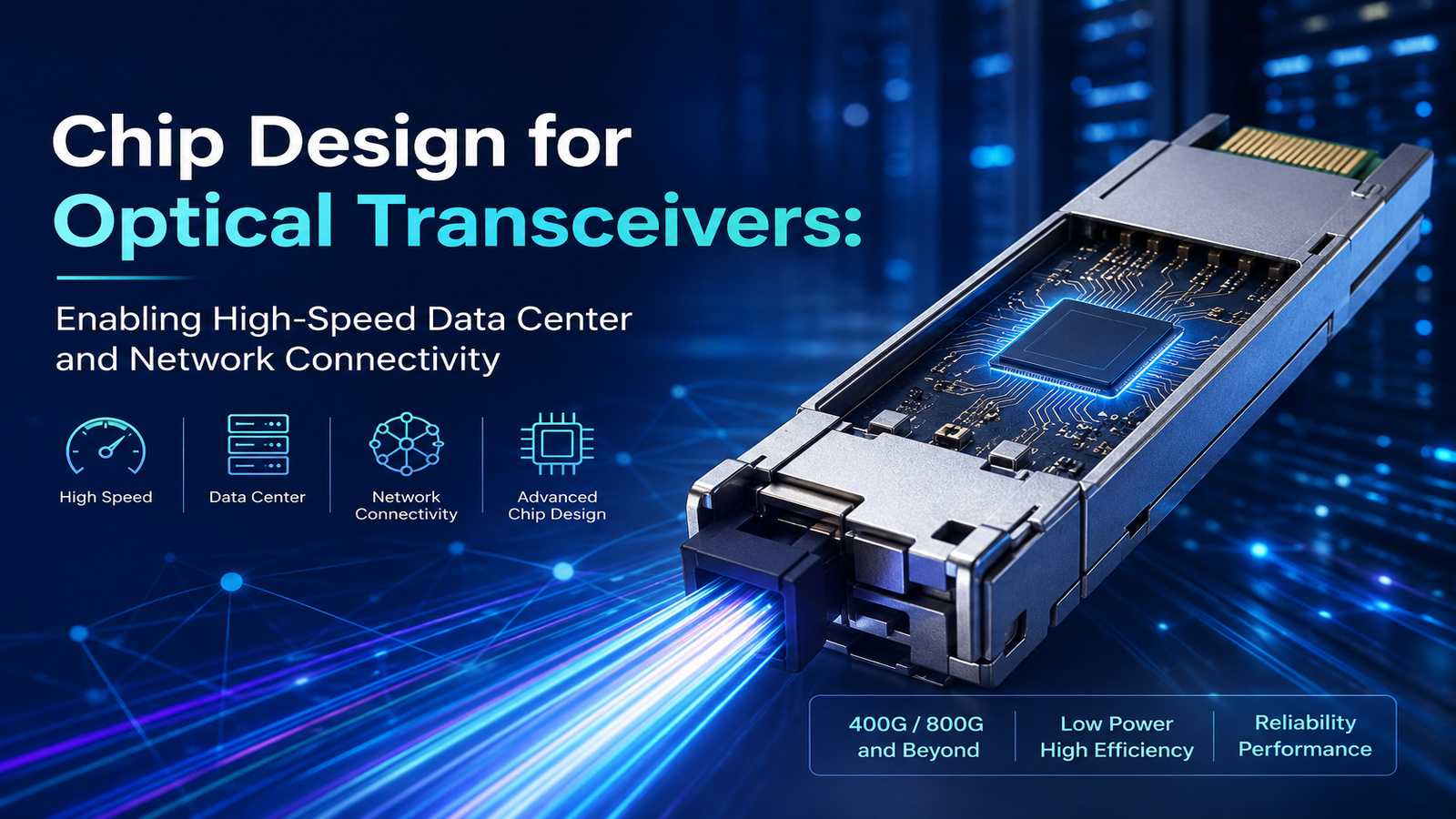
An optical transceiver is a communication module that combines a transmitter and receiver within a single device.
It enables data transmission through optical fiber by converting electrical signals into light signals for transmission and converting incoming optical signals back into electrical signals for processing.
Optical transceivers are widely used in:
-
Data centers
-
Cloud infrastructure
-
AI clusters
-
Telecom networks
-
Enterprise networking
-
High-performance computing systems
As networks transition to 400G, 800G, and future terabit-class links, the complexity of transceiver IC design continues to increase.
Why IC Design Is Critical for Optical Transceivers
Modern optical modules require multiple high-performance integrated circuits working together to maintain reliable communication.
The quality of these ICs directly affects:
-
Data throughput
-
Signal integrity
-
Bit error rate performance
-
Power efficiency
-
Thermal management
-
System reliability
Poor signal quality, excessive jitter, or inefficient power management can significantly impact overall network performance.
Carefully engineered mixed-signal and high-speed analog ICs help overcome these challenges while supporting increasingly demanding communication standards.
Key IC Components Used in Optical Transceivers
Laser Driver ICs
Laser driver ICs generate the electrical signals required to modulate optical transmitters.
They control laser operation while maintaining signal quality at extremely high data rates.
Key design considerations include:
-
Output linearity
-
Low jitter
-
High bandwidth
-
Power efficiency
-
Signal integrity
Laser drivers are particularly important in high-speed optical links used within modern data centers.
Transimpedance Amplifiers (TIAs)
A transimpedance amplifier converts the small current generated by a photodiode into a usable voltage signal.
TIAs are essential receiver-side components that influence overall sensitivity and signal quality.
Important design objectives include:
-
Low input-referred noise
-
High gain
-
Wide bandwidth
-
Stable operation across operating conditions
Clock and Data Recovery (CDR) ICs
CDRs recover timing information from incoming data streams and regenerate clean output signals.
These devices help compensate for channel impairments and maintain synchronization across high-speed optical links.
CDRs are commonly used in:
-
Datacenter interconnects
-
Optical networking equipment
-
High-speed communication systems
Signal Conditioning and Equalization Circuits
High-speed channels often introduce signal loss and distortion.
Signal conditioning circuits help compensate for these effects through equalization and signal restoration techniques that improve communication reliability.
Design Challenges in Optical Transceiver IC Development
Increasing Data Rates
As optical networks move beyond 400G and 800G, maintaining signal quality becomes increasingly difficult.
Higher bandwidth requirements place greater demands on analog performance, timing accuracy, and channel compensation techniques.
Power Consumption
Power efficiency remains a major consideration, particularly in large-scale data center deployments where thousands of transceivers may operate simultaneously.
Reducing power consumption without sacrificing performance is a primary design objective.
Signal Integrity
Maintaining signal integrity across high-speed channels requires careful management of:
-
Jitter
-
Noise
-
Channel loss
-
Crosstalk
-
Bandwidth limitations
Advanced mixed-signal design techniques help address these challenges.
Thermal Management
Higher performance often generates additional heat.
Optical transceiver ICs must be designed to operate reliably across varying thermal conditions while maintaining consistent performance.
Applications Driving Optical Transceiver Innovation
Hyperscale Data Centers
Cloud providers continue to deploy higher-speed optical links to support growing traffic demands and AI workloads.
Artificial Intelligence Infrastructure
AI clusters require low-latency communication between servers, accelerators, and storage resources.
High-performance optical interconnects help support these requirements.
High-Performance Computing
Research institutions and enterprise computing environments rely on optical communication technologies to move large datasets efficiently.
Telecommunications Networks
Optical transceivers remain essential components within metro, long-haul, and access network infrastructure.
How FMAX Technologies Supports Optical Communication IC Development
FMAX Technologies develops high-speed mixed-signal integrated circuits for communication, networking, datacenter, and instrumentation applications.
Our expertise includes technologies commonly used in advanced optical communication systems, including laser drivers, transimpedance amplifiers (TIAs), Clock and Data Recovery (CDR) devices, signal processing architectures, and high-speed connectivity solutions.
Through our mixed-signal IC design services, we help customers address the performance, signal integrity, and integration challenges associated with next-generation optical networking platforms.
The Future of Optical Transceiver IC Design
As network bandwidth requirements continue to grow, optical transceiver architectures will require increasingly sophisticated semiconductor technologies.
Future developments are expected to focus on:
-
Higher integration levels
-
Improved power efficiency
-
Faster optical interfaces
-
Advanced signal processing
-
Support for next-generation AI and cloud infrastructure
These advancements will continue to push the boundaries of mixed-signal and high-speed analog IC design.
Chip Design for Optical Transceivers
An optical transceiver is a device that transmits and receives data through optical fiber by converting electrical signals into optical signals and converting received optical signals back into electrical form.
Common components include laser driver ICs, transimpedance amplifiers (TIAs), Clock and Data Recovery (CDR) devices, and signal conditioning circuits.
Signal integrity directly affects data accuracy, communication reliability, and overall network performance, especially at higher transmission speeds.
A transimpedance amplifier converts the small current generated by a photodiode into a usable electrical signal for further processing.
They enable high-bandwidth, low-latency communication between servers, accelerators, storage systems, and networking equipment within AI infrastructure.